E-mail Us

AGF Series Solar String Device AGF-M24T 24 Circuits RS485

Jul 23, 2026

Table of Content [Hide]

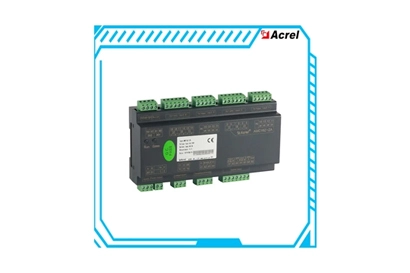
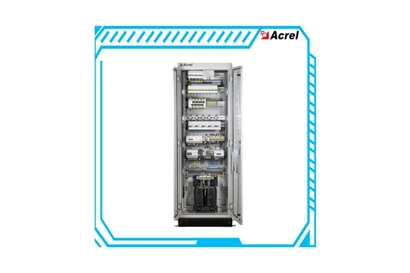
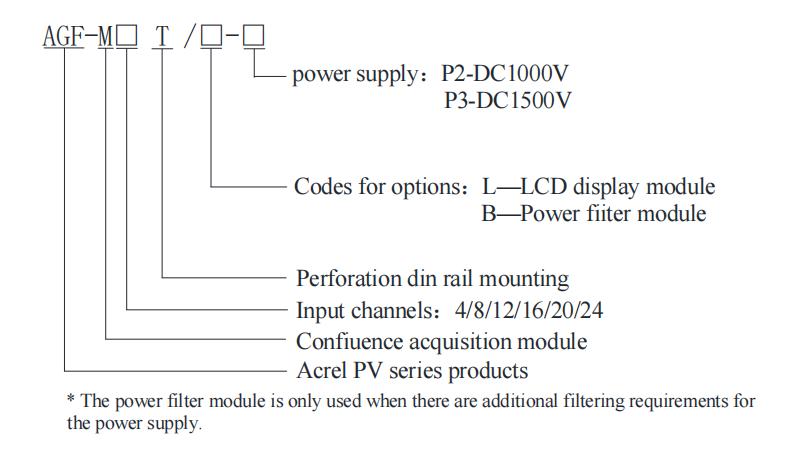
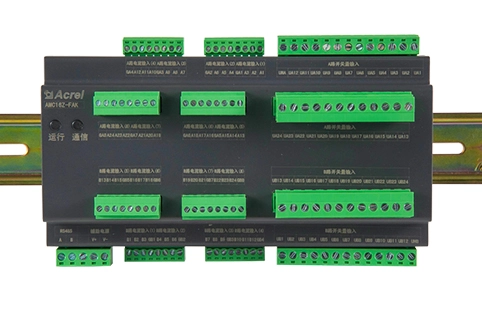
    The AGF-T perforated photovoltaic combiner acquisition device is specifically designed for use in intelligent photovoltaic combiner boxes. It is used to monitor the operating status of solar panels in photovoltaic arrays, measure string current, and acquire the status of surge protectors and DC circuit breakers in the combiner box. The device has an RS485 interface to upload the measured and acquired data and equipment status.


    agf-series-solar-string-device-agf-m24t-24-circuits-rs485-1.jpg


    Product Functions

    • Internal temperature measurement function, real-time measurement of the combiner box temperature.

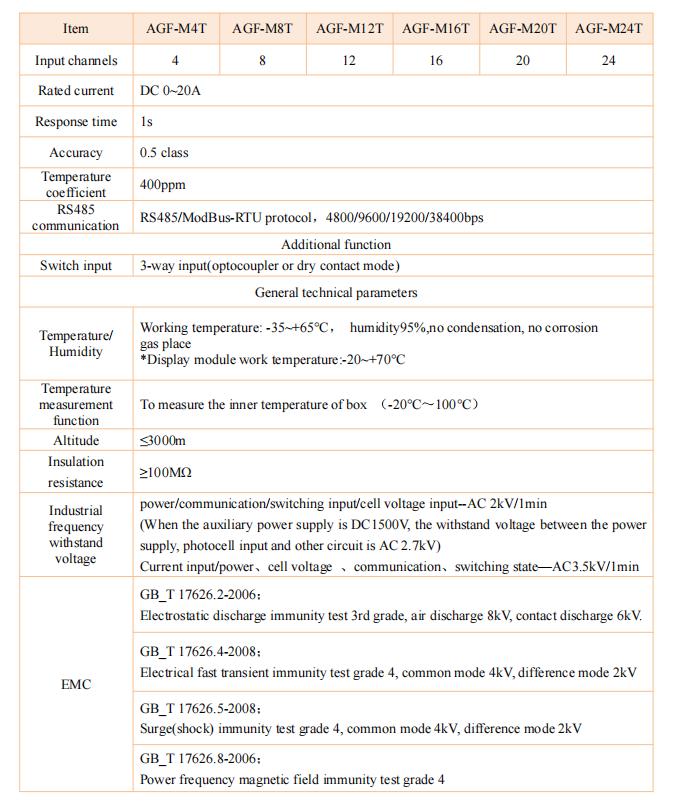
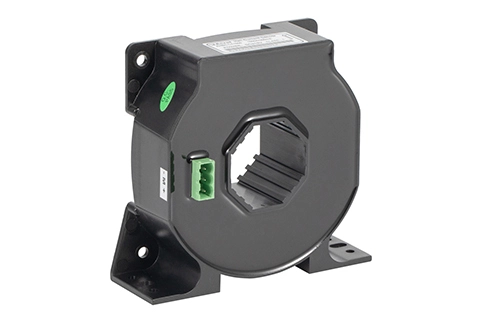
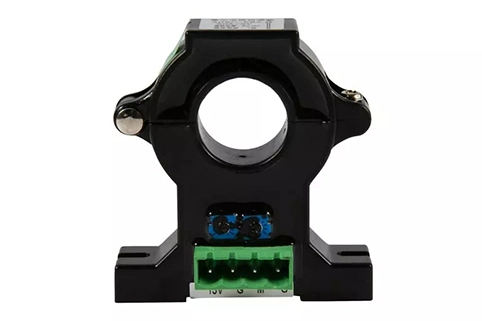
    • Utilizes a Hall effect sensor for measurement, isolating and measuring current up to 20A.

    • Voltage measurement function, capable of measuring bus voltage up to DC 1500V.

    • Photovoltaic cell string open-circuit alarm, which can be used in conjunction with string voltage for comprehensive judgment.

    • Includes 3-channel switch status monitoring, used to collect the status of output open contacts of DC circuit breakers, surge protectors, etc.

    • RS485 interface, Modbus RTU communication protocol, communication address, baud rate, and data mode are all freely configurable.


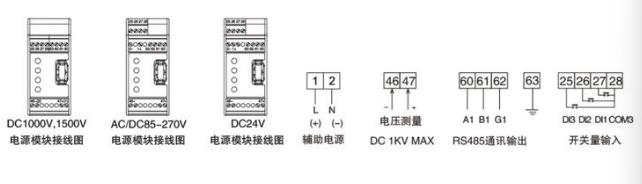
    Terminal blocks

    terminal-blocks.jpg


    Intelligent Photovoltaic Combiner Box Data Acquisition Device: The Nerve Center of Distributed Energy Monitoring

    Against the backdrop of the deepening "dual carbon" goals, rooftop photovoltaics is rapidly moving from demonstration projects to large-scale applications. Numerous small-scale distributed power stations have revealed common pain points: missing combiner box data, difficulty in locating branch anomalies, reliance on manual inspections for operation and maintenance, and delayed fault response. Acrel E-commerce (Shanghai) Co., Ltd.'s intelligent photovoltaic combiner box data acquisition device is a fundamental sensing node built to address this systemic shortcoming. It does not simply replace traditional combiner box monitoring units, but rather uses a 24-channel photovoltaic combiner detection device as its core, integrating high-precision current and voltage sampling, switch status recognition, temperature sensing, and RS485 communication protocol to form an intelligent terminal with edge detection capabilities. This device transforms originally discrete electrical parameters into a structured, traceable, and interconnected data stream, becoming the nerve ending of the entire photovoltaic monitoring system—without increasing the burden on the upper-level system, while significantly improving data reliability and real-time response.


    24-Channel Photovoltaic Combiner Detection Device: A Unified Approach of High-Density Data Acquisition and Anti-Interference Design

    Compared to the commonly available 8- or 16-channel solutions, this product employs a 24-channel photovoltaic combiner detection device architecture, allowing a single unit to cover all sub-string circuits of a medium-sized rooftop photovoltaic array. Each channel is equipped with an independent high-isolation DC current sensor (0–20A range, ±0.5%FS accuracy) and a wide-temperature-range DC voltage sampling channel (0–1000V), supporting industrial-grade operating environments from -25℃ to +70℃. The key lies in its anti-interference design: all analog input channels are protected by triple protection through magnetic coupling isolation, RC filtering, and software digital filtering, effectively suppressing electromagnetic crosstalk between strings and the influence of high-frequency harmonics from the inverter. Actual measurements show that under the condition of adjacent IGBT high-frequency switching operation, the current sampling fluctuation amplitude is less than 0.3%, far exceeding the requirements of GB/T 19964—2012 for combiner monitoring accuracy. This design is not about simply increasing the number of channels, but rather providing a data foundation for accurately reflecting progressive faults such as component degradation, hot spot evolution, and loose wiring.


    Rooftop PV Smart Combiner Data Acquisition Module: Lightweight Deployment for Residential and Commercial Scenarios

    Limited roof space, complex installation conditions, and narrow maintenance access are typical constraints for residential and small-to-medium-sized commercial and industrial PV projects. This product, a rooftop PV smart combiner data acquisition module, measures only 156mm × 102mm × 60mm. It adopts a DIN rail mounting and front wiring design, eliminating the need for additional wiring. Power is drawn from the combiner box's DC bus, eliminating the hassle of external power supplies. More importantly, its logical grouping capability is crucial: 24 channels can be freely divided into 4 groups, with each group of 6 channels sharing a single RS485 bus. Combined with the Modbus RTU protocol frame optimization mechanism, it ensures a 99.98% communication success rate even over wiring distances of hundreds of meters. This means that multiple modules can be deployed in parallel within a single distribution cabinet, enabling zoned management—for example, dividing roof arrays facing different directions into independent groups to facilitate analysis of the impact of azimuth and tilt angles on power generation efficiency, truly allowing data to serve refined operations.


    Multi-loop switch control device: Extending the closed loop from monitoring to execution.

    Mere "observation" does not equate to "controllability." This product integrates four optocoupler-isolated dry contact outputs, directly driving small DC contactors or signal relays to form a multi-loop switch control device. When the current in a certain circuit remains below a threshold for 5 minutes (parameters are configurable), the system automatically triggers a disconnect command for the corresponding branch to prevent the hot spot effect from escalating. If the internal temperature of the combiner box exceeds the limit, the cooling fan is activated. This localized closed-loop strategy significantly reduces reliance on cloud platforms, avoiding protection failure due to network interruptions. All switch actions are logged with event logs and SOE (Sequence of Events) timestamps down to the millisecond level, providing an immutable chain of evidence for accident reversal and liability determination. This transcends the scope of traditional data acquisition devices, becoming a smart power terminal with basic autonomous capabilities.


    Solar Panel Combinator Module: Triple Verification of Compatibility, Safety, and Long-Term Reliability

    As a front-end device directly connected to the solar panel's busbar, its safety is paramount. This product has passed CQC photovoltaic-specific certification, with insulation withstand voltage reaching DC3000V/1min. Creepage distance and clearance strictly adhere to IEC 61439-1 standards. The terminals use tin-plated copper with a spring-loaded connection structure, and the contact resistance change rate is <5% after 500 insertion/removal cycles. In terms of compatibility, it supports the nominal voltage of mainstream modules (600V/1000V/1500V systems), and the current input terminal has built-in self-resetting PTC overcurrent protection, ensuring that the sampling circuit will not be damaged in the event of reverse connection or short circuit. Acrel E-commerce (Shanghai) Co., Ltd. leverages the advantages of the electronic manufacturing industry chain in Shanghai Zhangjiang Science City. All PCBAs comply with the IPC-A-610 Level 3 standard and undergo 72 hours of high-temperature aging screening. This means that in the high-humidity and salt spray environment of East China, the annual failure rate of the equipment can be controlled within 0.3%, effectively ensuring stable operation of rooftop photovoltaic systems throughout their 25-year lifespan.


    Deep RS485 Protocol Adaptation: Bridging the Last Mile of System Integration

    RS485 is not a universal interface; its value lies in the engineering adaptability of the protocol layer. This product not only supports standard Modbus RTU but also incorporates Acrel's proprietary extended instruction set: supporting single-frame reading of 24 full parameters (including voltage, current, power, temperature, and switch status), batch writing of threshold and delay parameters, and proactive reporting of abnormal events. In a real-world project, after adopting this solution in a 12MW commercial and industrial rooftop project in Suzhou Industrial Park, the SCADA system polling cycle was reduced from 30 seconds to 8 seconds, and the data refresh frequency increased by 3.75 times. Due to the reduction of redundant messages, the RS485 bus load rate dropped to 42%, completely avoiding address conflicts and communication blockage issues when multiple devices are connected in parallel. This protocol-level optimization makes the intelligent photovoltaic combiner acquisition device a truly reliable data source for the upper-level system, rather than a "black box" requiring additional middleware development.


    Choosing the right path determines the O&M paradigm: from reactive emergency repairs to proactive prevention.

    The value of a photovoltaic (PV) power plant lies not only in its initial installed capacity but also in the stability of its power generation revenue over its 25-year lifespan. A reliable 24-channel PV combiner detection system means that 3-5 potential hotspots and 2-3 potential contact defects can be detected annually, avoiding an average of 72 hours of power generation loss due to a single failure. When the rooftop PV intelligent combiner acquisition module, multi-loop switch control device, and solar panel combiner module form a functional closed loop, the O&M model shifts from "fault-driven" to "data-driven." Acrel E-commerce (Shanghai) Co., Ltd. provides not only hardware but also a PV asset management methodology embedded in the product logic. For owners planning new projects or urgently needing to upgrade existing power plants, choosing this path now lays the foundation for a stable asset health over the next decade.

    Aaron Shi
    Aaron Shi

    Electrical Engineer Expert, Providing Service, consultant, product expert, professional manufacturer of energy efficiency management systemic solutions, and energy meters.

    References