E-mail Us

Acrel DC energy meter multi-scenario solution

Feb 09, 2026

Table of Content [Hide]

    With the rapid development of charging piles, photovoltaic energy storage, base stations, DC power distribution, and other fields, the demand for highly adaptable DC power measurement is becoming increasingly prominent. Acrel, addressing industry pain points and leveraging its comprehensive product portfolio and core technologies, has launched a full-scenario solution for DC power meters. This solution, with its product coverage, high-precision measurement performance, and flexible scenario adaptation, meets the diverse measurement needs of different fields, providing reliable support for operation and energy management across various industries.


    I. Market Size and Growth Drivers

    Currently, the global DC power meter market is experiencing rapid growth, driven by four core sectors: charging piles, photovoltaic energy storage, base stations, and DC power distribution. The global market size is projected to reach $1.4 billion by 2025, with a compound annual growth rate (CAGR) exceeding 15%. Among these, the charging pile sector, driven by the rapid development of the new energy vehicle industry, has seen a surge in demand, becoming one of the core engines of market growth. The photovoltaic energy storage sector benefits from global energy transition policies, with installed capacity continuously increasing, leading to a synchronous increase in demand for DC power meters. The large-scale deployment of 5G base stations has further expanded the application scenarios and market demand for DC power meters. Technological upgrades and scenario expansion in the DC power distribution sector are also injecting new momentum into market growth. These four sectors working together are jointly propelling the DC power meter market towards leapfrog development.


    II. Pain Points and Needs Breakdown in Different Application Scenarios

    The operating environment and technical requirements of different application scenarios vary significantly, leading to different focuses in the core needs of DC energy meters. Acrel has deeply analyzed the pain points of each scenario to clarify targeted product demand orientations: Charging Pile Scenarios: The core needs are high cost-effectiveness, complete certifications, and measurement performance to adapt to the diverse installation and long-term stable operation requirements of charging piles, ensuring accurate and reliable energy metering during the charging process. Photovoltaic Energy Storage System Scenarios: Large-scale energy storage power stations often adopt a 1500V high-voltage architecture, placing strict requirements on the high-voltage monitoring capabilities of DC energy meters. Hall effect sensors are required to achieve safe and reliable measurement under high-voltage environments, ensuring the stable operation of the energy storage system. Base Station Scenarios: Base station equipment has a compact layout and limited space; therefore, DC energy meters need to be small in size. Furthermore, base station operation involves strong electromagnetic interference, requiring meters to have excellent anti-electromagnetic interference capabilities to avoid interference affecting metering accuracy. DC power distribution scenario: The voltage range is wide, and it needs to be compatible with different voltage levels from 48V to 1000V. The installation method is mainly door panel installation. At the same time, it needs to support multi-protocol communication to ensure seamless compatibility with other equipment in the power distribution system and realize intelligent management and control of the power distribution system.


    III. Product Matrix and Scenario Adaptation To address the differentiated needs of various scenarios, Acrel has constructed a diversified DC energy meter product matrix. Guided by technical specifications, the matrix ensures product compatibility with specific scenarios. The detailed compatibility is shown in the table below: Product Model


    IV. Product Technical Analysis Among Acrel's DC energy meter product matrix, several core products, with their unique technological advantages, have become the preferred solutions for various scenarios. The following is a detailed analysis of the product's technical characteristics and application scenarios:

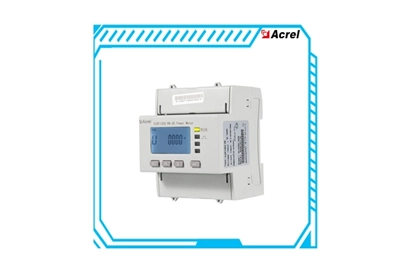
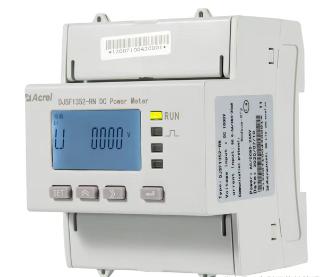
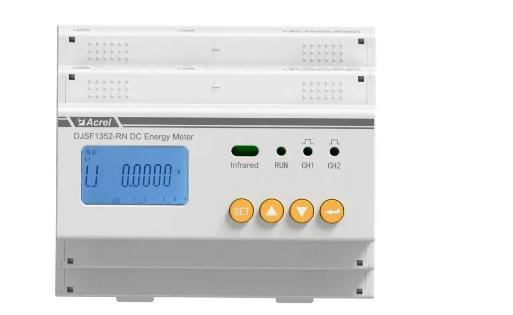
    (I) All-Round Product: The DJSF1352-RN is an all-round product adaptable to multiple scenarios. It supports dual DC inputs, with flexible adjustment of voltage and current parameters. It also features ±12V voltage output, which can directly power Hall sensors, simplifying system wiring and equipment configuration. This product has complete certifications, having passed CE, CPA, and UL certifications, meeting compliance requirements in different regions and scenarios. In terms of communication compatibility, it incorporates multiple communication protocols including Modbus-RTU, DLT645-07, DLT698, and YD1363, enabling seamless integration with control systems in various scenarios such as charging piles, energy storage systems, base stations, and DC power distribution, achieving power data transmission and intelligent management. In addition, this product can be used with a shunt or a Hall sensor. The shunt has high precision and is used in charging pile scenarios; the Hall sensor adopts an electrical isolation design, which has stronger safety and reliability and is suitable for complex scenarios such as high voltage and high current.


    acrel-dc-energy-meter-multi-scenario-solution-1.jpg

    acrel-dc-energy-meter-multi-scenario-solution-2.jpg

    (II) High-Current Direct-Connect Products: DJSF1352-D Series.

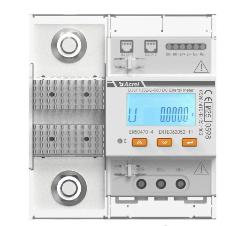
    The DJSF1352-D series is specifically designed for DC charging pile scenarios, including 360A and 600A specifications. It adopts a direct-connect design, eliminating the need for additional sensors and effectively reducing equipment costs and installation complexity. This series boasts excellent temperature adaptability, with a design temperature range of -40℃ to +70℃, adapting to the operational needs of different regions and environments, preventing temperature-related impacts on metering accuracy and equipment lifespan. In terms of communication, it incorporates Modbus-RTU, DLT645-07, and DLT698 protocols, ensuring compatibility with charging pile control systems and enabling real-time acquisition and transmission of electrical energy data during charging. The 600A specification is specifically designed for supercharging scenarios, meeting the metering requirements of high-power charging piles.


    (III) High-Voltage Energy Storage Dedicated Product: DJSF1352-RN-6

    The DJSF1352-RN-6 is a dedicated DC energy meter designed for 1500V high-voltage photovoltaic energy storage systems. It supports dual DC inputs, adjustable voltage and current, and is equipped with ±12V voltage output, which can directly power Hall effect sensors, adapting to the measurement needs of high-voltage energy storage power stations. This product is feature-rich, with optional analog outputs to meet user needs. It supports wireless module expansion for wireless transmission of energy data, enhancing the flexibility of system management. In terms of communication, it incorporates multiple mainstream communication protocols to meet the intelligent management needs of energy storage systems. With a measurement accuracy of 0.5%, it can capture energy changes under high-voltage conditions, providing reliable data support for the operation and energy-saving optimization of energy storage systems. Currently, UL certification for this product is underway, and future expansion into overseas markets is planned.


    acrel-dc-energy-meter-multi-scenario-solution-5.jpg

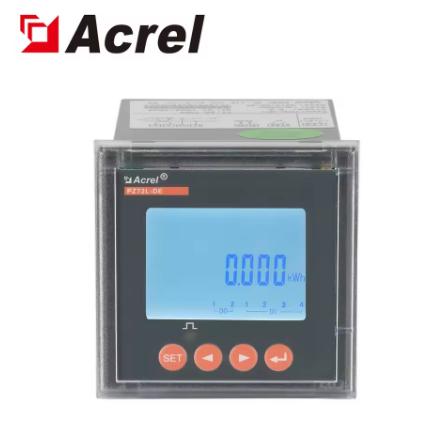
    (iv) Panel-mounted integrated products: PZ72L-DE, PZ96L-DEP. The PZ72L-DE and PZ96L-DE adopt a panel-mount design, allowing direct embedding into energy storage cabinets and power distribution cabinets, saving installation space and adapting to the integrated installation needs of photovoltaic energy storage, DC power distribution, and other scenarios. This series of products can be equipped with ±12V voltage output to power Hall sensors according to user needs. The PZ96L-DE supports 1500V high-voltage measurement with a measurement accuracy of 0.5%, specifically designed for high-voltage photovoltaic energy storage and DC power distribution scenarios; the PZ72L-DE is compatible with voltage levels of 1000V and below, meeting the measurement needs of medium and low-voltage scenarios. Both products have built-in Modbus-RTU, DLT645-07, and DLT698 protocols, ensuring strong communication compatibility and seamless integration with other devices in the system for centralized management of power data.


    acrel-dc-energy-meter-multi-scenario-solution-6.jpg

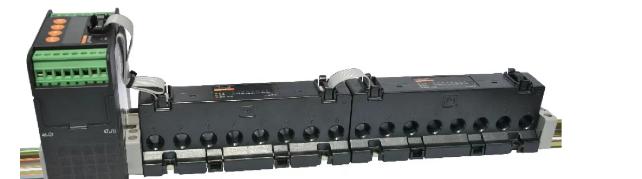
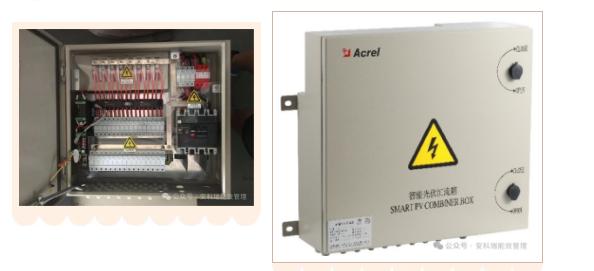
    (IV) Photovoltaic Combiner Monitoring Product: AGF-MT The AGF-MT is specifically designed for combiner monitoring scenarios in 1500V centralized photovoltaic systems. Its core advantage lies in its ability to freely expand the circuit, effectively reducing the wiring between the photovoltaic array and the inverter, optimizing the structural layout of the photovoltaic system, and lowering system wiring costs and fault risks. This product uses a through-hole method to connect the primary current, supporting up to 30A (standard 20A). Installation is convenient and quick, and it does not require direct contact with the circuit, thus enhancing safety. It is mainly used in photovoltaic combiner boxes to monitor the combiner power data of each photovoltaic module, providing a reliable basis for photovoltaic system power optimization and fault diagnosis, and helping to improve the power generation efficiency of the photovoltaic system.


    acrel-dc-energy-meter-multi-scenario-solution-7.jpg


    acrel-dc-energy-meter-multi-scenario-solution-8.jpg

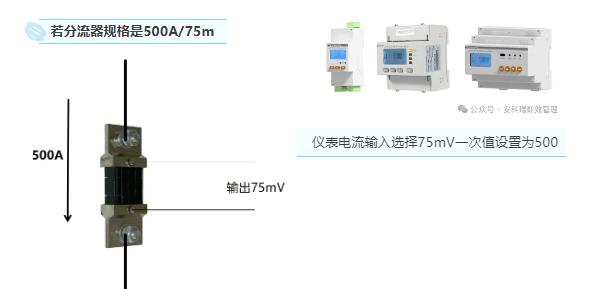
    Ⅴ.Matching Sensors DC energy meter measurements rely heavily on matching sensors. Acrel offers two main types of matching products for different scenarios: shunts and Hall effect sensors. Each type has its own advantages and disadvantages, and the choice can be made flexibly according to the characteristics of the scenario. Specific characteristics and usage instructions are as follows: (I) Shunt The shunt is designed based on a simple resistance principle and is a cost-effective current measurement element. Its core advantages are reflected in four aspects: First, it is simple and cost-effective, with a simple structure and low price, making it easy to achieve batch application and installation; second, it has high measurement accuracy, providing very accurate current measurement data under ideal operating conditions, suitable for medium and low voltage scenarios with high accuracy requirements; third, it has a fast response, directly measuring the current through the resistor, and can quickly capture real-time changes in the current; fourth, it has excellent wideband characteristics, maintaining stable measurement performance under a wide range of temperature and current conditions, and adapting to various complex operating environments. However, shunts also have certain limitations: First, they generate heat and energy loss; current flowing through a resistor produces heat, wasting energy and potentially affecting the operation of surrounding equipment. Second, they cause voltage drops, which may slightly impact the overall circuit performance. Third, their size is limited; for high-current applications, shunts need to be larger to avoid overheating, increasing installation space requirements. Fourth, they are sensitive to the external environment; changes in environmental factors such as temperature and humidity may affect their measurement accuracy. The use of shunts must strictly adhere to the specification matching principle. For example, if a shunt is specified as 500A/75mV, its maximum current measurement value is 500A, corresponding to an output voltage of 75mV. In this case, the instrument's current input should be selected as 75mV, and the instrument's primary value should be set to 500 to ensure the accuracy of the measurement data.

    acrel-dc-energy-meter-multi-scenario-solution-9.jpg

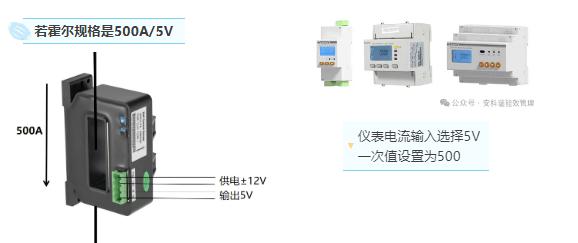
    (II) Hall Sensors Hall sensors are designed based on the principle of magnetic field induction and employ a non-contact measurement method. They are the preferred sensors for high-voltage and high-current scenarios. Their core advantages include: First, non-contact measurement eliminates the need for direct contact with the circuit, preventing additional voltage drops and energy loss, thus saving energy. Second, they are suitable for high-current measurement; their non-contact nature allows them to easily handle high-current measurement needs without overheating concerns. Third, they exhibit excellent high-temperature resistance; their measurement performance is less affected by temperature changes, making them adaptable to various temperature environments. Fourth, they offer flexible installation and high safety; the absence of direct contact with the circuit reduces safety risks during installation and use, making them suitable for high-voltage, flammable, and explosive environments. The limitations of Hall sensors are mainly reflected in: First, higher cost; compared to shunts, their price is higher, increasing the overall system cost. Second, complex structure and signal processing require complex signal processing circuits, increasing the difficulty of system design. Third, insufficient low-current sensitivity; in low-current applications, their measurement accuracy is lower than that of shunts. Fourth, susceptibility to interference; the presence of external magnetic fields may affect their measurement accuracy, requiring anti-interference measures. The use of Hall sensors must also follow the specification matching principle and be equipped with a dedicated power supply. For example, if the Hall sensor specification is 500A/5V, its maximum current measurement value is 500A, and the corresponding output voltage is 5V. When using it, the instrument current input should be selected as 5V, the primary value should be set to 500, and ±12V power supply should be provided to the sensor to ensure normal operation and measurement accuracy.


    acrel-dc-energy-meter-multi-scenario-solution-10.jpg

    Ⅵ.Conclusion Acrel's full-scenario DC energy meter solution is market-demand oriented and supported by core technologies. Through a comprehensive product matrix adaptable to various scenarios and reliable technical performance, it covers charging piles, photovoltaic energy storage, base stations, DC power distribution, and other scenarios, effectively solving metering pain points in various fields. From all-around products to specialized equipment, from the products themselves to supporting sensors, Acrel combines accuracy, reliability, cost-effectiveness, and adaptability, providing strong energy metering support for intelligent upgrades and energy conservation in various industries. In the future, Acrel will continue to deepen its expertise in the DC energy metering field, keep abreast of industry technology development trends, continuously optimize its products and solutions, and contribute to the global energy transition.

    Aaron Shi
    Aaron Shi

    Electrical Engineer Expert, Providing Service, consultant, product expert, professional manufacturer of energy efficiency management systemic solutions, and energy meters.

    References